
Meeting Coralie, Deep Time Walk Facilitator
At the beginning of this year, we wanted to meet the facilitators of the Deep Time Walk whom we have trained. First, to understand what this practice brings them, how it evolves and becomes more solid. But also to highlight the beautiful and growing community of Deep Time Walk facilitators. This month, we give the floor to Coralie, trained in 2025 and already rich in hands‑on experience. Between wonder, constant adaptation, and unexpected encounters, she shares how the walk transforms her… and the participants.
A sensitive dive into the practice, to be discovered through her interview.
How would you describe the Deep Time Walk to someone who has never heard of it?
For me, the Deep Time Walk is an immersive experience, an interactive walk that helps us become aware of our relationship to the Earth and of our impact in relation to current challenges. I like to emphasize that it is not only a guided walk but also a narrated one: we tell a story to participants as they walk. But it is also an immersive experience. During the walk, paced by the stations, a series of activities gradually unfold, and the animations that engage the body allow kinesthetic memory to anchor the rich and dense information shared along the way.
A transformative walk to question, to understand, and to experience our relationship to the Earth through time.
What struck you most during your first walk?
During the first walk I took part in, what impressed me most was the huge acceleration during the last meter — and I think that’s the case for many people.
As for the first walk I facilitated, what struck me were the participants’ reflections. I remember someone saying: “So if I understand correctly, for four billion years, sight didn’t exist.” It really caught my attention that this is what they focused on — we live in a time where the visual is omnipresent…
Participants’ reactions and questions are so varied and thought‑provoking every time.
Based on your experience, when you say the last meter struck you the most the first time you did the walk, what sensation did you feel?
A sensation of vertigo, like falling from the top of a cliff, and of acceleration! And also the feeling of being a grain of sand in this whole system. A sense of smallness, while being completely integrated into this incredible living world.
What emotions accompany you when you guide a walk?
The emotion that accompanies me each time is wonder at the intelligence of the living world. It’s something that reaches me every time, through the content itself but also through interactions with participants, the relevance of their questions, and their moments of awareness.
Which part of the walk still touches you today?
I always hesitate to choose just one moment, because many stations touch me. I truly love each of them. But the Oceanic Earth station moved me deeply from my very first walk. I knew there had been periods of glaciation and warming, but imagining that the entire Earth could once have been a giant drop of water… that profoundly surprised me.
What struck me most was realizing that the water cycle has existed for billions of years, and that the water that makes up our bodies has gone through countless states — liquid, gaseous, solid — and interacted with multiple forms of life: a plant, an animal, maybe even my neighbor. It nourishes my reflection on “living together.”
Another station that touches me deeply is the Carboniferous. It helps us understand that it took twenty‑five million years for the wood of the immense forests of that era to turn into coal. And when you put that into perspective with the end of the walk, when we arrive at the industrial era and the staggering acceleration of resource consumption, you realize how humans have become super‑predators. You walk for a long time before humans appear in the story, and in just a few centimeters, you see how they disrupt and destroy ecosystems.hat chllenges do you encounter as a walk facilitator?
What challenges do you encounter as a walk facilitator?
During a walk, you have to manage both distance and time while staying attentive to the group. For example, if participants show particular curiosity for a station, as a facilitator you may choose to go deeper and stay longer. Which means adapting the following stations to stay within the timing. It’s a challenge, but at the same time, it encourages us to transform and adapt constantly — just as the living world has done for billions of years.
Each walk is different because each group has its own DNA. To make their experience as immersive as possible, it’s important to be observant and adaptive. Even if you know the narrative, the distance, and the time it takes to go from one station to another, you have to stay alive!
This walk also pushes us, as facilitators, not to stay too much in our heads, but to be deeply attuned to the group’s sensations. It’s not easy. But it’s a beautiful life lesson.
What motivates you to guide walks?
I love sharing things that I’ve experienced and that have moved me. In the Deep Time Walk, there are different moments of transmission: each person can leave with a different action depending on what touched them during the walk. This aspect of moving into action seems important to me.
You facilitate both the Climate Fresk and the Deep Time Walk. What differentiates these two experiences?
The Deep Time Walk offers a much less anxiety‑inducing experience than the Climate Fresk, where participants often stay in their heads and sometimes leave feeling stressed. Walking in a natural setting, soothed by trees, sounds, and landscape, helps people enter more deeply into feeling and into long time scales. The movement of the body allows them to gain perspective and approach the issues with more distance. Unlike the passive posture of the Fresk, the walk truly puts people in motion, physically and internally. It also creates a more horizontal collective dynamic: we stop together, share, and build on each other’s feelings. Exchanges continue between stations, fluidly and spontaneously. By regularly changing partners, participants encounter a diversity of energies, from anxious to optimistic. In the end, they feel more engaged, less stressed, and already ready to take action.
How has your practice evolved over time?
Over time, I’ve expanded the toolbox I use to facilitate, which is interesting because we use different tools depending on the group. And that brings us back to the notion of adaptation we already talked about, which for me is one of the characteristics of the living world.
I’ve also gained confidence in the way I share, in taking the leap, and in using my toolbox and making it my own to become autonomous.
Do you have a memorable anecdote to share?
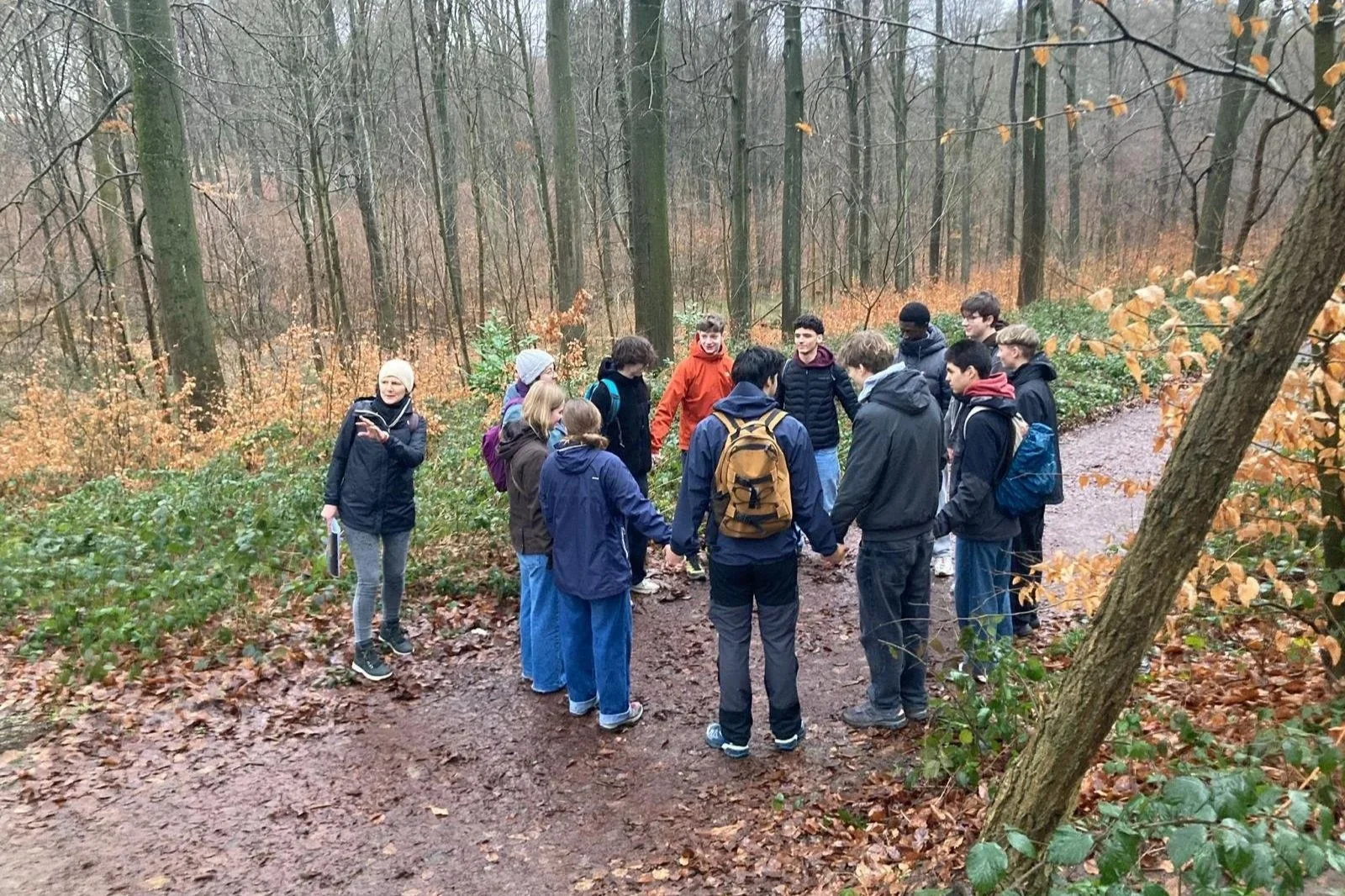
During a Deep Time Walk in the rain with high‑school seniors, I discovered a group far more receptive than I expected. Despite the downpours, they remained engaged, curious, and insightful, asking questions that adults never ask. Even the activities in the mud were welcomed with enthusiasm. This experience challenged my assumptions: young people can be deeply involved when offered a living, embodied framework.